LFSR
在介绍LFSR(线性反馈移位寄存器)之前,我们先对它的归属有一个大致的了解,LFSR是属于FSR(反馈移位寄存器)的一种,除了LFSR之外,还包括NFSR(非线性反馈移位寄存器)。
基本介绍
下面在有限域F p F_{p} F p
反馈函数
a i + n = ∑ j = 1 n c j a i + n − j a_{i+n} = \sum_{j=1}^{n} c_j a_{i+n-j}
a i + n = j = 1 ∑ n c j a i + n − j
既然反馈函数是一个线性变换,我们可以得知这个线性变换为
[ a i + 1 , a i + 2 , … , a i + n ] = [ a i , a i + 1 , … , a i + n − 1 ] [ 0 0 ⋯ 0 c n 1 0 ⋯ 0 c n − 1 0 1 ⋯ 0 c n − 2 ⋮ ⋮ ⋱ ⋮ ⋮ 0 0 ⋯ 1 c 1 ] [ a i + 1 , a i + 2 , … , a i + n ] = [ a 0 , a 1 , … , a n − 1 ] [ 0 0 ⋯ 0 c n 1 0 ⋯ 0 c n − 1 0 1 ⋯ 0 c n − 2 ⋮ ⋮ ⋱ ⋮ ⋮ 0 0 ⋯ 1 c 1 ] i + 1 \begin{array}{rcl}
[a_{i+1}, a_{i+2}, \ldots, a_{i+n}] & = &
[a_i, a_{i+1}, \ldots, a_{i+n-1}]
\begin{bmatrix}
0 & 0 & \cdots & 0 & c_n \\
1 & 0 & \cdots & 0 & c_{n-1} \\
0 & 1 & \cdots & 0 & c_{n-2} \\
\vdots & \vdots & \ddots & \vdots & \vdots \\
0 & 0 & \cdots & 1 & c_1
\end{bmatrix}
\\[10pt]
\phantom{[a_{i+1}, a_{i+2}, \ldots, a_{i+n}]} & = &
[a_0, a_1, \ldots, a_{n-1}]
\begin{bmatrix}
0 & 0 & \cdots & 0 & c_n \\
1 & 0 & \cdots & 0 & c_{n-1} \\
0 & 1 & \cdots & 0 & c_{n-2} \\
\vdots & \vdots & \ddots & \vdots & \vdots \\
0 & 0 & \cdots & 1 & c_1
\end{bmatrix}^{i+1}
\end{array}
[ a i + 1 , a i + 2 , … , a i + n ] [ a i + 1 , a i + 2 , … , a i + n ] = = [ a i , a i + 1 , … , a i + n − 1 ] ⎣ ⎢ ⎢ ⎢ ⎢ ⎢ ⎢ ⎡ 0 1 0 ⋮ 0 0 0 1 ⋮ 0 ⋯ ⋯ ⋯ ⋱ ⋯ 0 0 0 ⋮ 1 c n c n − 1 c n − 2 ⋮ c 1 ⎦ ⎥ ⎥ ⎥ ⎥ ⎥ ⎥ ⎤ [ a 0 , a 1 , … , a n − 1 ] ⎣ ⎢ ⎢ ⎢ ⎢ ⎢ ⎢ ⎡ 0 1 0 ⋮ 0 0 0 1 ⋮ 0 ⋯ ⋯ ⋯ ⋱ ⋯ 0 0 0 ⋮ 1 c n c n − 1 c n − 2 ⋮ c 1 ⎦ ⎥ ⎥ ⎥ ⎥ ⎥ ⎥ ⎤ i + 1
特征多项式
进而,我们可以求得其特征多项式为
f ( x ) = x n − ∑ i = 1 n c i x n − i f(x) = x^n - \sum_{i=1}^n c_i x^{n - i}
f ( x ) = x n − i = 1 ∑ n c i x n − i
同时,我们定义其互反多项式为
f ‾ ( x ) = x n f ( 1 x ) = 1 − ∑ i = 1 n c i x i \overline{f}(x) = x^n f\left(\frac{1}{x}\right) = 1 - \sum_{i=1}^n c_i x^i
f ( x ) = x n f ( x 1 ) = 1 − i = 1 ∑ n c i x i
p=2的特殊情况
当p=2时,只有{0,1}两种情况,此时用异或代替原来的模p加法运算。c i ∈ { 0 , 1 } c_{i} \in \{0,1\} c i ∈ { 0 , 1 }
f ( a 1 , a 2 , ⋯ , a n ) = c n a 1 ⊕ c n − 1 a 2 ⊕ ⋯ ⊕ c 1 a n f(a_{1}, a_{2}, \cdots, a_{n}) = c_{n} a_{1} \oplus c_{n-1} a_{2} \oplus \cdots \oplus c_{1} a_{n}
f ( a 1 , a 2 , ⋯ , a n ) = c n a 1 ⊕ c n − 1 a 2 ⊕ ⋯ ⊕ c 1 a n
进一步得到特征多项式:
f ( x ) = x n − ∑ i = 1 n c i x n − i = x n + c 1 x n − 1 + c 2 x n − 2 + ⋯ + c n − 1 x + c n f(x) = x^n - \sum_{i=1}^n c_i x^{n - i}=x^{n}+c_{1}x^{n-1}+c_{2}x^{n-2}+\cdots+c_{n-1}x+c_{n}
f ( x ) = x n − i = 1 ∑ n c i x n − i = x n + c 1 x n − 1 + c 2 x n − 2 + ⋯ + c n − 1 x + c n
这里为什么减法变成加法(?):在模2意义下加减是一样的。 F 2 F_{2} F 2
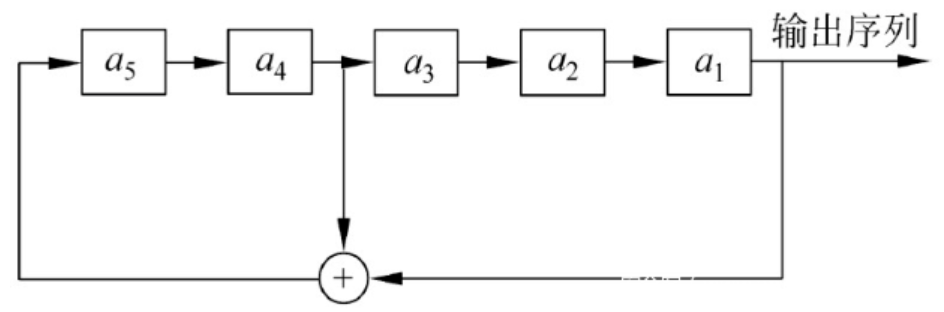
f ( a 1 , a 2 , a 3 , a 4 , a 5 ) = a 1 ⊕ a 4 f(a_{1}, a_{2}, a_{3},a_{4}, a_{5}) = a_{1} \oplus a_{4}
f ( a 1 , a 2 , a 3 , a 4 , a 5 ) = a 1 ⊕ a 4
规定初始状态为( a 1 , a 2 , a 3 , a 4 , a 5 ) = ( 1 , 0 , 0 , 1 , 1 ) (a_{1}, a_{2}, a_{3},a_{4}, a_{5})=(1,0,0,1,1) ( a 1 , a 2 , a 3 , a 4 , a 5 ) = ( 1 , 0 , 0 , 1 , 1 ) a 1 = 1 a_{1}=1 a 1 = 1 ( a 1 , a 2 , a 3 , a 4 , a 5 ) = ( 0 , 0 , 1 , 1 , 0 ) (a_{1}, a_{2}, a_{3},a_{4}, a_{5})=(0,0,1,1,0) ( a 1 , a 2 , a 3 , a 4 , a 5 ) = ( 0 , 0 , 1 , 1 , 0 ) a 1 = 0 a_{1}=0 a 1 = 0 ( a 1 , a 2 , a 3 , a 4 , a 5 ) = ( 0 , 1 , 1 , 0 , 1 ) (a_{1}, a_{2}, a_{3},a_{4}, a_{5})=(0,1,1,0,1) ( a 1 , a 2 , a 3 , a 4 , a 5 ) = ( 0 , 1 , 1 , 0 , 1 ) 为什么写到31(?)因为如果继续下去会得到重复的序列也就是说序列的周期为31。
周期
对于有限域F p F_{p} F p p n − 1 p^{n}-1 p n − 1 为什么是p n − 1 p^{n}-1 p n − 1 p n p^{n} p n p n − 1 p^{n}-1 p n − 1 f ( x ) f(x) f ( x ) F p F_{p} F p f ( x ) ∣ ( x k − 1 ) f(x) \mid (x^{k}-1) f ( x ) ∣ ( x k − 1 ) f ( x ) f(x) f ( x )
f ( x ) = x 5 + x 2 + 1 f(x)=x^{5}+x^{2}+1
f ( x ) = x 5 + x 2 + 1
而
f ( x ) ∣ x 31 − 1 f(x) \mid x^{31}-1
f ( x ) ∣ x 3 1 − 1
可以得到上面举例的LFSR的周期是31,符合我们遍历的结果。也可以看出这个周期是5级LFSR的最大周期,故特征多项式是本原的。
本原多项式
设 f ( x ) f(x) f ( x ) G F ( p ) \mathrm{GF}(p) G F ( p ) n n n
f ( x ) = x n − c 1 x n − 1 − c 2 x n − 2 − ⋯ − c n f(x) = x^n - c_1 x^{n-1} - c_2 x^{n-2} - \cdots - c_n
f ( x ) = x n − c 1 x n − 1 − c 2 x n − 2 − ⋯ − c n
若 f ( x ) f(x) f ( x ) α \alpha α G F ( p n ) \mathrm{GF}(p^n) G F ( p n )
α p n − 1 = 1 且 α k ≠ 1 对所有 1 ≤ k < p n − 1 \alpha^{p^n - 1} = 1 \quad \text{且} \quad \alpha^k \ne 1 \quad \text{对所有 } 1 \le k < p^n - 1
α p n − 1 = 1 且 α k = 1 对所有 1 ≤ k < p n − 1
那么称 f ( x ) f(x) f ( x ) G F ( p ) \mathrm{GF}(p) G F ( p )
换句话说:f ( x ) f(x) f ( x ) G F ( p n ) \mathrm{GF}(p^n) G F ( p n )
总结
左移型
( a 0 , a 1 , a 2 , ⋯ , a n − 1 ) ⋅ [ 0 0 ⋯ 0 c 0 1 0 ⋯ 0 c 1 0 1 ⋯ 0 c 2 ⋮ ⋮ ⋱ ⋮ ⋮ 0 0 ⋯ 1 c n − 1 ] = ( a 1 , a 2 , a 3 , ⋯ , a n ) (a_0,a_1,a_2,\cdots,a_{n-1}) \cdot
\begin{bmatrix}
0 & 0 & \cdots & 0 & c_0 \\
1 & 0 & \cdots & 0 & c_{1} \\
0 & 1 & \cdots & 0 & c_{2} \\
\vdots & \vdots & \ddots & \vdots & \vdots \\
0 & 0 & \cdots & 1 & c_{n-1}
\end{bmatrix}
=(a_1,a_2,a_3,\cdots,a_n)
( a 0 , a 1 , a 2 , ⋯ , a n − 1 ) ⋅ ⎣ ⎢ ⎢ ⎢ ⎢ ⎢ ⎢ ⎡ 0 1 0 ⋮ 0 0 0 1 ⋮ 0 ⋯ ⋯ ⋯ ⋱ ⋯ 0 0 0 ⋮ 1 c 0 c 1 c 2 ⋮ c n − 1 ⎦ ⎥ ⎥ ⎥ ⎥ ⎥ ⎥ ⎤ = ( a 1 , a 2 , a 3 , ⋯ , a n )
[ a 0 a 1 ⋯ a n − 1 a 1 a 2 ⋯ a n ⋮ ⋮ ⋮ a n − 1 a n − 2 ⋯ a 2 n − 2 ] ⋅ [ c 0 c 1 ⋮ c n − 1 ] = [ a n a n + 1 ⋮ a 2 n − 1 ] \begin{bmatrix}
a_{0} & a_{1} & \cdots & a_{n-1} \\
a_1 & a_{2} & \cdots & a_{n} \\
\vdots & \vdots & & \vdots \\
a_{n-1} & a_{n-2} & \cdots & a_{2n-2}
\end{bmatrix}
\cdot
\begin{bmatrix}
c_0 \\
c_1 \\
\vdots \\
c_{n-1}
\end{bmatrix}=
\begin{bmatrix}
a_n \\
a_{n+1} \\
\vdots \\
a_{2n-1}
\end{bmatrix}
⎣ ⎢ ⎢ ⎢ ⎢ ⎡ a 0 a 1 ⋮ a n − 1 a 1 a 2 ⋮ a n − 2 ⋯ ⋯ ⋯ a n − 1 a n ⋮ a 2 n − 2 ⎦ ⎥ ⎥ ⎥ ⎥ ⎤ ⋅ ⎣ ⎢ ⎢ ⎢ ⎢ ⎡ c 0 c 1 ⋮ c n − 1 ⎦ ⎥ ⎥ ⎥ ⎥ ⎤ = ⎣ ⎢ ⎢ ⎢ ⎢ ⎡ a n a n + 1 ⋮ a 2 n − 1 ⎦ ⎥ ⎥ ⎥ ⎥ ⎤
对应脚本如下
1
2
3
4
5
6
7
8
9
10
11
12
13
14
15
16
17
18
19
def recover_c(output,n,p=2): M=[] for i in range(n): M.append(output[i:i+n]) M=matrix(GF(p),M) vec=vector(GF(p),output[n:2*n]) c=M.solve_right(vec) return list(c) def solve_lfsr_left(output,n,d,p=2): c_list=recover_c(output,n) a_list=output[:n] vec=vector(GF(p),a_list) M=matrix(GF(p),n,n) for i in range(n): M[i,n-1]=c_list[i] for i in range(n-1): M[i+1,i]=1 res=vec*M^(-d) print(long_to_bytes(int(''.join(str(x) for x in res),2)))
右移型
( a n − 1 , a n − 2 , , ⋯ , a 1 , a 0 ) ⋅ [ c n − 1 1 ⋯ 0 0 c n − 2 0 ⋯ 0 0 ⋮ ⋮ ⋱ ⋮ ⋮ c 1 0 ⋯ 0 1 c 0 0 ⋯ 0 0 ] = ( a n , a n − 1 , ⋯ , a 2 , a 1 ) (a_{n-1},a_{n-2},,\cdots,a_1,a_{0}) \cdot
\begin{bmatrix}
c_{n-1} & 1 & \cdots & 0 & 0 \\
c_{n-2} & 0 & \cdots & 0 & 0 \\
\vdots & \vdots & \ddots & \vdots & \vdots \\
c_{1} & 0 & \cdots & 0 & 1 \\
c_0 & 0 & \cdots & 0 & 0
\end{bmatrix}
=(a_n,a_{n-1},\cdots,a_2,a_1)
( a n − 1 , a n − 2 , , ⋯ , a 1 , a 0 ) ⋅ ⎣ ⎢ ⎢ ⎢ ⎢ ⎢ ⎢ ⎡ c n − 1 c n − 2 ⋮ c 1 c 0 1 0 ⋮ 0 0 ⋯ ⋯ ⋱ ⋯ ⋯ 0 0 ⋮ 0 0 0 0 ⋮ 1 0 ⎦ ⎥ ⎥ ⎥ ⎥ ⎥ ⎥ ⎤ = ( a n , a n − 1 , ⋯ , a 2 , a 1 )
[ a n − 1 a n − 2 ⋯ a 0 a n a n − 1 ⋯ a 1 ⋮ ⋮ ⋮ a 2 n − 2 a 2 n − 3 ⋯ a n − 1 ] ⋅ [ c n − 1 c n − 2 ⋮ c 0 ] = [ a n a n + 1 ⋮ a 2 n − 1 ] m o d 2 \begin{bmatrix}
a_{n-1} & a_{n-2} & \cdots & a_0 \\
a_n & a_{n-1} & \cdots & a_1 \\
\vdots & \vdots & & \vdots \\
a_{2n-2} & a_{2n-3} & \cdots & a_{n-1}
\end{bmatrix}
\cdot
\begin{bmatrix}
c_{n-1} \\
c_{n-2} \\
\vdots \\
c_{0}
\end{bmatrix}=
\begin{bmatrix}
a_n \\
a_{n+1} \\
\vdots \\
a_{2n-1}
\end{bmatrix}
\mod 2
⎣ ⎢ ⎢ ⎢ ⎢ ⎡ a n − 1 a n ⋮ a 2 n − 2 a n − 2 a n − 1 ⋮ a 2 n − 3 ⋯ ⋯ ⋯ a 0 a 1 ⋮ a n − 1 ⎦ ⎥ ⎥ ⎥ ⎥ ⎤ ⋅ ⎣ ⎢ ⎢ ⎢ ⎢ ⎡ c n − 1 c n − 2 ⋮ c 0 ⎦ ⎥ ⎥ ⎥ ⎥ ⎤ = ⎣ ⎢ ⎢ ⎢ ⎢ ⎡ a n a n + 1 ⋮ a 2 n − 1 ⎦ ⎥ ⎥ ⎥ ⎥ ⎤ m o d 2
对应脚本如下
1
2
3
4
5
6
7
8
9
10
11
12
13
14
15
16
17
18
19
def recover_c(output,n,p=2): M=[] for i in range(n): M.append(output[i:i+n:][::-1]) M=matrix(GF(p),M) vec=vector(GF(p),output[n:2*n]) c=M.solve_right(vec) return list(c) def solve_lfsr_right(output,n,d,p=2): c_list=recover_c(output,n) a_list=output[:n][::-1] vec=vector(GF(p),a_list) M=matrix(GF(p),n,n) for i in range(n): M[i,0]=c_list[i] for i in range(n-1): M[i,i+1]=1 res=vec*M^(-d) print(long_to_bytes(int(''.join(str(x) for x in res),2)))
例题
moectf2024-EzMatrix
题目
Can you break my LFSR?
1
2
3
4
5
6
7
8
9
10
11
12
13
14
15
16
17
18
19
20
21
22
from Crypto.Util.number import *from secret import FLAG,secrets,SECERT_Tassert len (secrets) == 16 assert FLAG == b'moectf{' + secrets + b'}' assert len (SECERT_T) <= 127 class LFSR : def __init__ (self ): self ._s = list (map (int ,list ("{:0128b}" .format (bytes_to_long(secrets))))) for _ in range (8 *len (secrets)): self .clock() def clock (self ): b = self ._s[0 ] c = 0 for t in SECERT_T:c ^= self ._s[t] self ._s = self ._s[1 :] + [c] return b def stream (self, length ): return [self .clock() for _ in range (length)] c = LFSR() stream = c.stream(256 ) print ("" .join(map (str ,stream))[:-5 ])
分析
题目构造了在F 2 F_{2} F 2 c i c_i c i
[ a i + 1 , a i + 2 , … , a i + n ] = [ a i , a i + 1 , … , a i + n − 1 ] [ 0 0 ⋯ 0 c n 1 0 ⋯ 0 c n − 1 0 1 ⋯ 0 c n − 2 ⋮ ⋮ ⋱ ⋮ ⋮ 0 0 ⋯ 1 c 1 ] [ a i + 1 , a i + 2 , … , a i + n ] = [ a 0 , a 1 , … , a n − 1 ] [ 0 0 ⋯ 0 c n 1 0 ⋯ 0 c n − 1 0 1 ⋯ 0 c n − 2 ⋮ ⋮ ⋱ ⋮ ⋮ 0 0 ⋯ 1 c 1 ] i + 1 \begin{array}{rcl}
[a_{i+1}, a_{i+2}, \ldots, a_{i+n}] & = &
[a_i, a_{i+1}, \ldots, a_{i+n-1}]
\begin{bmatrix}
0 & 0 & \cdots & 0 & c_n \\
1 & 0 & \cdots & 0 & c_{n-1} \\
0 & 1 & \cdots & 0 & c_{n-2} \\
\vdots & \vdots & \ddots & \vdots & \vdots \\
0 & 0 & \cdots & 1 & c_1
\end{bmatrix}
\\[10pt]
\phantom{[a_{i+1}, a_{i+2}, \ldots, a_{i+n}]} & = &
[a_0, a_1, \ldots, a_{n-1}]
\begin{bmatrix}
0 & 0 & \cdots & 0 & c_n \\
1 & 0 & \cdots & 0 & c_{n-1} \\
0 & 1 & \cdots & 0 & c_{n-2} \\
\vdots & \vdots & \ddots & \vdots & \vdots \\
0 & 0 & \cdots & 1 & c_1
\end{bmatrix}^{i+1}
\end{array}
[ a i + 1 , a i + 2 , … , a i + n ] [ a i + 1 , a i + 2 , … , a i + n ] = = [ a i , a i + 1 , … , a i + n − 1 ] ⎣ ⎢ ⎢ ⎢ ⎢ ⎢ ⎢ ⎡ 0 1 0 ⋮ 0 0 0 1 ⋮ 0 ⋯ ⋯ ⋯ ⋱ ⋯ 0 0 0 ⋮ 1 c n c n − 1 c n − 2 ⋮ c 1 ⎦ ⎥ ⎥ ⎥ ⎥ ⎥ ⎥ ⎤ [ a 0 , a 1 , … , a n − 1 ] ⎣ ⎢ ⎢ ⎢ ⎢ ⎢ ⎢ ⎡ 0 1 0 ⋮ 0 0 0 1 ⋮ 0 ⋯ ⋯ ⋯ ⋱ ⋯ 0 0 0 ⋮ 1 c n c n − 1 c n − 2 ⋮ c 1 ⎦ ⎥ ⎥ ⎥ ⎥ ⎥ ⎥ ⎤ i + 1
但是我们这里并不知道c i c_{i} c i c i c_{i} c i
a t = c 1 a t − 1 ⊕ c 2 a t − 2 ⊕ ⋯ ⊕ c n a t − n a_t = c_1 a_{t-1} \oplus c_2 a_{t-2} \oplus \cdots \oplus c_n a_{t-n}
a t = c 1 a t − 1 ⊕ c 2 a t − 2 ⊕ ⋯ ⊕ c n a t − n
其中,a t a_t a t t t t c 1 , c 2 , … , c n ∈ F 2 c_1, c_2, \dots, c_n \in \mathbb{F}_2 c 1 , c 2 , … , c n ∈ F 2 ⊕ \oplus ⊕ F 2 \mathbb{F}_2 F 2
假设已知长度为 2 n 2n 2 n ( a 0 , a 1 , … , a 2 n − 1 ) (a_0, a_1, \dots, a_{2n-1}) ( a 0 , a 1 , … , a 2 n − 1 )
[ a n − 1 a n − 2 ⋯ a 0 a n a n − 1 ⋯ a 1 ⋮ ⋮ ⋮ a 2 n − 2 a 2 n − 3 ⋯ a n − 1 ] ⋅ [ c 1 c 2 ⋮ c n ] = [ a n a n + 1 ⋮ a 2 n − 1 ] m o d 2 \begin{bmatrix}
a_{n-1} & a_{n-2} & \cdots & a_0 \\
a_n & a_{n-1} & \cdots & a_1 \\
\vdots & \vdots & & \vdots \\
a_{2n-2} & a_{2n-3} & \cdots & a_{n-1}
\end{bmatrix}
\cdot
\begin{bmatrix}
c_1 \\
c_2 \\
\vdots \\
c_n
\end{bmatrix}=
\begin{bmatrix}
a_n \\
a_{n+1} \\
\vdots \\
a_{2n-1}
\end{bmatrix}
\mod 2
⎣ ⎢ ⎢ ⎢ ⎢ ⎡ a n − 1 a n ⋮ a 2 n − 2 a n − 2 a n − 1 ⋮ a 2 n − 3 ⋯ ⋯ ⋯ a 0 a 1 ⋮ a n − 1 ⎦ ⎥ ⎥ ⎥ ⎥ ⎤ ⋅ ⎣ ⎢ ⎢ ⎢ ⎢ ⎡ c 1 c 2 ⋮ c n ⎦ ⎥ ⎥ ⎥ ⎥ ⎤ = ⎣ ⎢ ⎢ ⎢ ⎢ ⎡ a n a n + 1 ⋮ a 2 n − 1 ⎦ ⎥ ⎥ ⎥ ⎥ ⎤ m o d 2
即矩阵形式为:
M ⋅ c ⃗ = v ⃗ m o d 2 M \cdot \vec{c} = \vec{v} \mod 2
M ⋅ c = v m o d 2
通过求解这个方程组,可以还原 LFSR 的反馈系数 c ⃗ = ( c 1 , c 2 , … , c n ) \vec{c} = (c_1, c_2, \dots, c_n) c = ( c 1 , c 2 , … , c n )
脚本
1
2
3
4
5
6
7
8
9
10
11
12
13
14
15
16
17
18
19
20
21
22
23
24
25
26
27
28
29
30
31
32
33
from Crypto.Util.number import * for i in range(32): output = "11111110011011010000110110100011110110110101111000101011001010110011110011000011110001101011001100000011011101110000111001100111011100010111001100111101010011000110110101011101100001010101011011101000110001111110100000011110010011010010100100000000110" brutebits = bin(i)[2:].zfill(5) output += brutebits F = GF(2) n = 128 V = VectorSpace(F,n) vec = V(list(map(int, list(output[n:])))) M = [] for i in range(n-1,2*n-1): m = [] for j in range(n): m.append(output[i-j]) M.append(m) M = Matrix(F,M) try: sol = M.solve_right(vec) except ValueError: continue poly = list(sol) B = Matrix(F,n,n) for i in range(n): B[i,n-1] = poly[n-1-i] for i in range(n-1): B[i+1,i] = 1 try: B_inv = B**(-1) t = V(list(map(int,list(output[:n])))) print(long_to_bytes(int("".join(map(str,t*B_inv**(n))),2))) except ZeroDivisionError: continue #b'e4sy_lin3ar_sys!'
ciscn2018-oldstreamgame
题目
1
2
3
4
5
6
7
8
9
10
11
12
13
14
15
16
17
18
19
20
21
22
23
24
flag = "flag{xxxxxxxxxxxxxxxx}" assert flag.startswith("flag{" )assert flag.endswith("}" )assert len (flag)==14 def lfsr (R,mask ): output = (R << 1 ) & 0xffffffff i=(R&mask)&0xffffffff lastbit=0 while i!=0 : lastbit^=(i&1 ) i=i>>1 output^=lastbit return (output,lastbit) R=int (flag[5 :-1 ],16 ) mask = 0b10100100000010000000100010010100 f=open ("key" ,"w" ) for i in range (100 ): tmp=0 for j in range (8 ): (R,out)=lfsr(R,mask) tmp=(tmp << 1 )^out f.write(chr (tmp)) f.close()
分析
题目构造了在F 2 F_{2} F 2
1
2
output = (R << 1 ) & 0xffffffff i=(R&mask)&0xffffffff
这里首先把R像左移1位,然后&0xffffffff把首位去掉,得到末尾是0的output。关键是这里的i的构造过程,R和mask都是32位,后面&0xffffffff其实没什么用处。在F 2 F_{2} F 2
( i 1 , i 2 , ⋯ , i 32 ) = ( r 1 a 1 , r 2 a 2 , ⋯ , r 32 a 32 ) (i_{1},i_{2},\cdots,i_{32})=(r_{1}a_{1},r_{2}a_{2},\cdots,r_{32}a_{32})
( i 1 , i 2 , ⋯ , i 3 2 ) = ( r 1 a 1 , r 2 a 2 , ⋯ , r 3 2 a 3 2 )
1 2 3 4 5 lastbit=0 while i!=0 : lastbit^=(i&1 ) i=i>>1 output^=lastbit
while循环内的过程就是模拟r 1 a 1 ⊕ r 2 a 2 ⊕ ⋯ ⊕ r 32 a 32 r_{1}a_{1} \oplus r_{2}a_{2} \oplus \cdots \oplus r_{32}a_{32} r 1 a 1 ⊕ r 2 a 2 ⊕ ⋯ ⊕ r 3 2 a 3 2
1 2 3 4 5 6 7 8 f=open ("key" ,"w" ) for i in range (100 ): tmp=0 for j in range (8 ): (R,out)=lfsr(R,mask) tmp=(tmp << 1 )^out f.write(chr (tmp)) f.close()
这里执行了100*8次LFSR过程,其中每8次得到一个8位字符然后打印在文件里,过程重复100次。但是我们解决这道题目肯定不需要这么多次,只需要前32次就够我们得到一个序列然后还原得到明文即可。这里的key是网上摘的别人的数据,不清楚为什么不是ASCII字符串而是十六进制字符,神秘。
脚本
1
2
3
4
5
6
7
8
9
10
11
12
13
14
15
16
17
18
19
mask="10100100000010000000100010010100" key='00100000111111011110111011111000' F=GF(2) V = VectorSpace(F,32) vec = V(list(map(int, list(key)))) mask=list(map(int, list(mask))) M=matrix(F,32,32) for i in range(32): M[i,31]=mask[i] for i in range(31): M[i+1,i]=1 M_inv=M**(-1) vec=vec*M_inv**32 vec=[1, 0, 0, 1, 0, 0, 1, 0, 0, 1, 1, 0, 0, 0, 1, 0, 0, 0, 0, 0, 0, 0, 0, 1, 1, 1, 0, 1, 0, 1, 1, 1] res=0 for i in vec: res=res*2+i print(hex(res)) #flag{926201d7}